Missing teeth can affect more than the way your smile looks. They can change how you chew, speak, bite, and maintain daily oral hygiene. Over time, untreated tooth loss may also cause nearby teeth to shift, opposing teeth to over-erupt, and the jawbone to shrink in the missing tooth area.
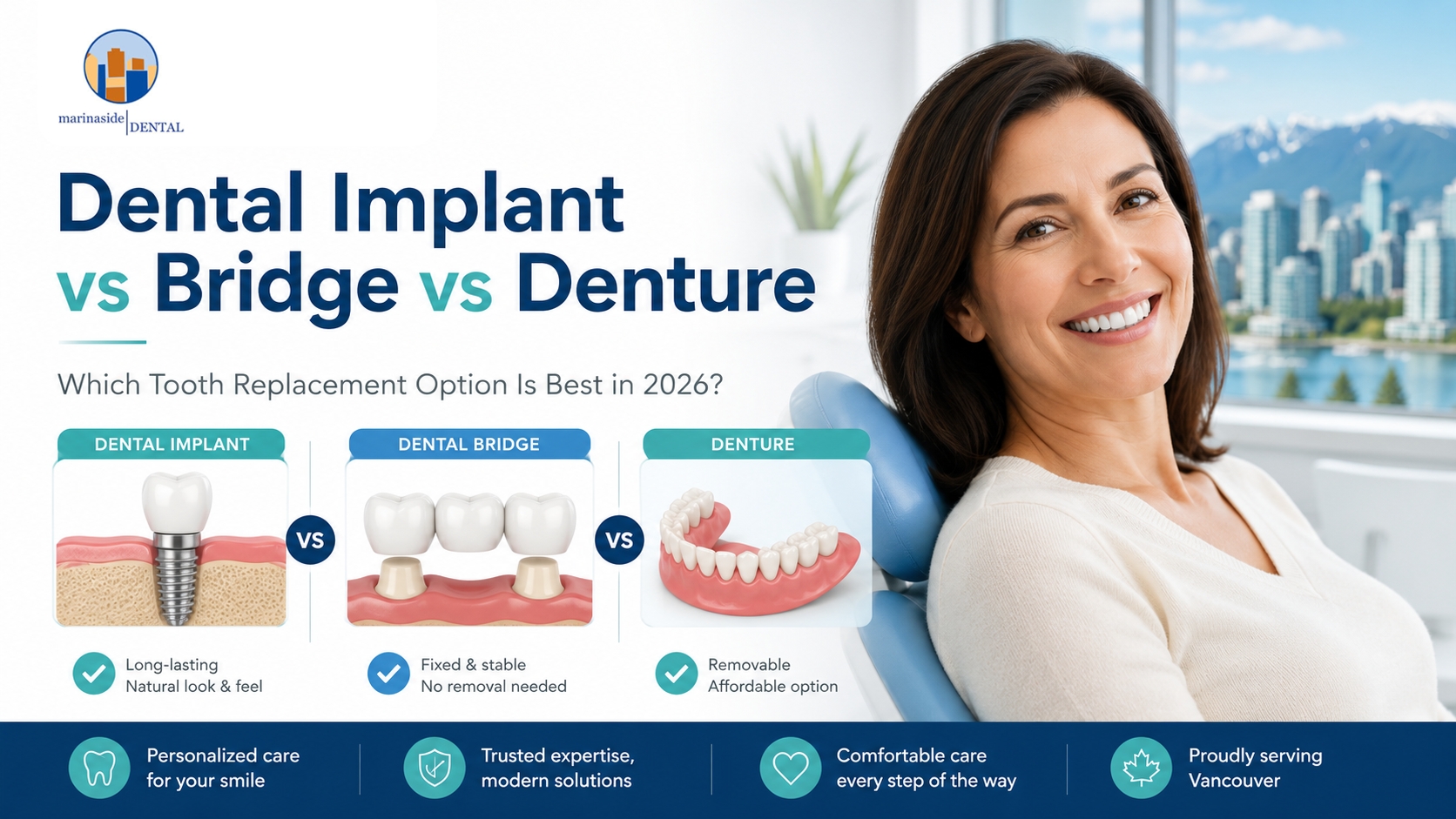
In 2026, patients have several reliable tooth replacement options, including dental implants, dental bridges, and dentures. Each treatment can restore appearance and function, but the best choice depends on your gum health, bone support, number of missing teeth, lifestyle, budget, and long-term goals.
If you are comparing a dental implant Vancouver BC option with bridges or dentures, this guide will help you understand the main differences. At Marinaside Dental, our team provides personalized restorative care for patients in Yaletown and surrounding Vancouver communities.
Why Replacing Missing Teeth Matters
Every tooth helps support your bite. When one or more teeth are missing, the surrounding teeth may slowly move into the empty space. This can affect your occlusion, which is the way your upper and lower teeth meet when you bite.
Missing teeth can also make it harder to chew evenly. Some patients begin chewing more on one side, which can place extra pressure on remaining teeth and jaw joints. Over time, this may contribute to tooth wear, jaw discomfort, food trapping, gum irritation, and further dental problems.
Tooth roots also help stimulate the jawbone. When a tooth root is lost, the surrounding bone may begin to shrink through a process called bone resorption. Replacing missing teeth can help protect your bite, support facial structure, and improve confidence when smiling or speaking.
What Is a Dental Implant?
A dental implant is a small titanium or ceramic post placed into the jawbone to replace a missing tooth root. After placement, the implant gradually bonds with the bone through a process called osseointegration. Once healed, the implant can support a crown, bridge, or denture.
For one missing tooth, an implant is usually restored with a custom dental crown. For multiple missing teeth, implants may support a bridge or help stabilize dentures.
Many patients choose dental implants and extractions because implants replace both the root and visible tooth structure. This can provide strong chewing support and a natural-feeling result.
A dental implant may be suitable if you have healthy gums, enough jawbone volume, and want a fixed replacement option that does not rely on neighbouring teeth. However, implants require surgery, healing time, and careful treatment planning.
What Is a Dental Bridge?
A dental bridge is a fixed restoration used to replace one or more missing teeth. A traditional bridge includes an artificial tooth, called a pontic, attached to crowns on the neighbouring teeth. These supporting teeth are called abutment teeth.
Because the bridge is cemented in place, it does not need to be removed like a denture. It can restore chewing ability, improve smile appearance, and help prevent nearby teeth from shifting into the gap.
A bridge may be recommended when the adjacent teeth are strong enough for support, when nearby teeth already need crowns, or when implant treatment is not preferred or not suitable.
Marinaside Dental offers crowns and bridges to help repair damaged teeth and replace missing teeth with restorations designed for comfort, function, and natural appearance.
What Is a Denture?
A denture is a removable appliance used to replace missing teeth. A partial denture replaces some missing teeth while using remaining natural teeth for support. A complete denture replaces all teeth in the upper or lower arch.
Dentures can be a practical option for patients missing several or all teeth. They can improve chewing, speech, facial support, and smile appearance. They may also be suitable for patients who want a more budget-conscious option or who are not ready for implant treatment.
Modern dentures are more natural-looking than older designs, but they still require daily cleaning, proper fit, and periodic adjustments. Since gums and jawbone can change over time, dentures may need relines or replacement to remain comfortable.
Dental Implant vs Bridge vs Denture: Main Differences
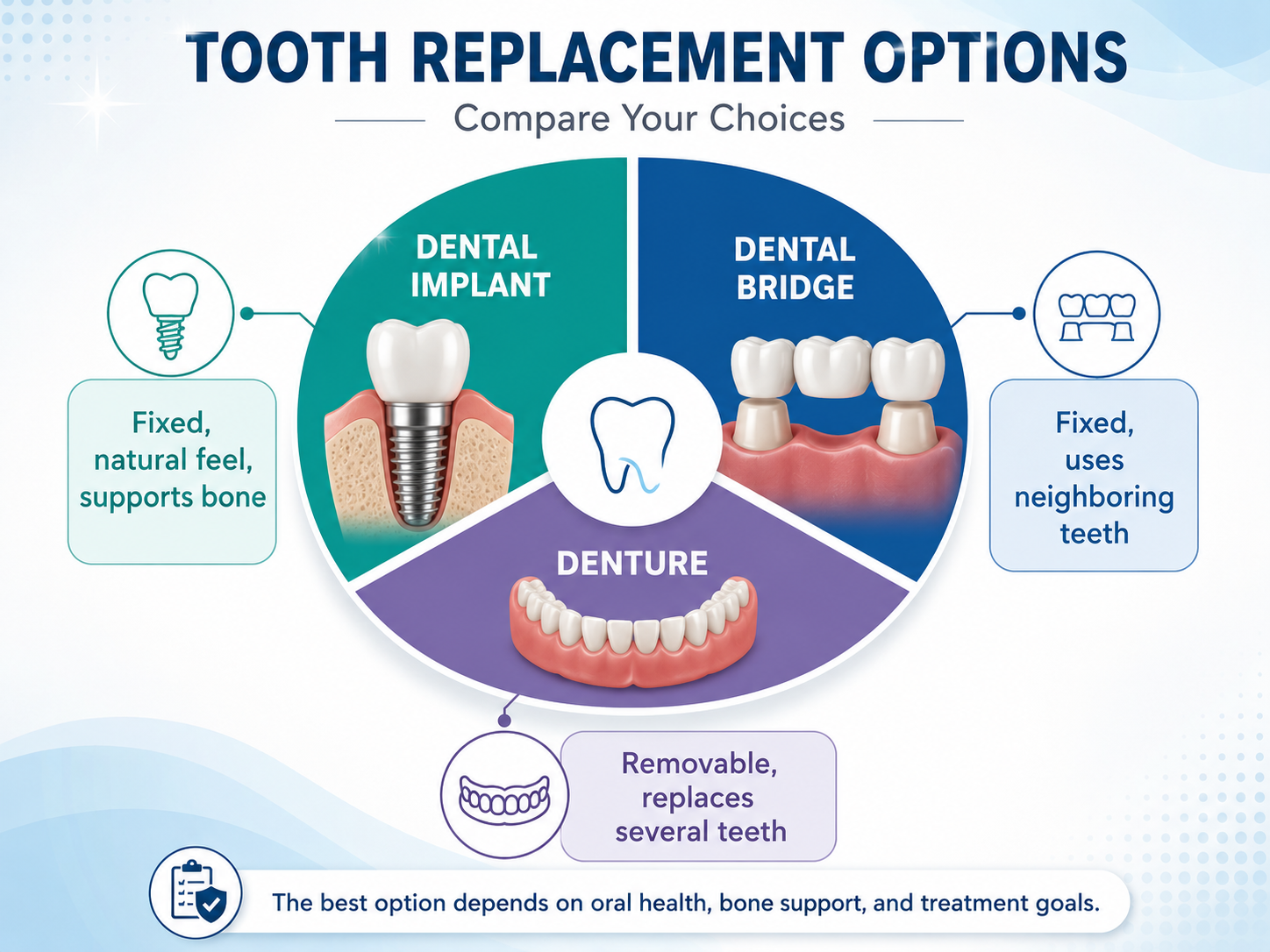
The main difference is how each option is supported.
- A dental implant is supported by the jawbone and replaces the tooth root.
- A dental bridge is supported by neighbouring teeth or implants.
- A denture rests on the gums and may be supported by natural teeth or implants.
For patients researching restorative dentistry Vancouver, the right option depends on the condition of the mouth, not just the number of missing teeth.
Benefits and Considerations of Dental Implants
Dental implants are often chosen because they feel stable and function similarly to natural teeth. Since they are anchored into the jawbone, they can provide strong chewing support and help maintain bone stimulation in the implant area.
Implants also do not require reshaping healthy neighbouring teeth, which can be a major benefit when replacing a single tooth.
However, implants are not ideal for every patient. Treatment involves surgery and may take several months from placement to final restoration. Patients need enough bone volume and healthy gum tissue. Gum disease, smoking, uncontrolled diabetes, certain medications, or medical conditions may affect healing and implant success.
A consultation with a dentist in Vancouver can help determine whether implants are appropriate for your oral health and medical history.
Benefits and Considerations of Dental Bridges
Dental bridges are fixed in place, which makes them more stable than removable dentures. They can restore chewing, improve speech, and close visible gaps in the smile. In many cases, bridges can also be completed faster than implant treatment.
A bridge may be a good option when the teeth beside the gap already need crowns. In this situation, the bridge can restore the missing tooth while also strengthening the neighbouring teeth.
The main consideration is that traditional bridges usually require reshaping the adjacent teeth. Bridges also need careful cleaning under the pontic and around the supporting crowns. Floss threaders, interdental brushes, or water flossers may help maintain hygiene around the bridge.
Benefits and Considerations of Dentures
Dentures can replace several or all missing teeth and may be more affordable than implant treatment. They are often non-surgical and can improve facial support, chewing ability, and smile appearance.
Dentures are also flexible because they can be partial or complete depending on how many teeth are missing. In some cases, implants may be used to stabilize dentures for better comfort and chewing strength.
The main consideration is that traditional dentures are removable and may move during eating or speaking. They also require daily removal and cleaning. Some patients need time to adjust to chewing and speaking with dentures.
Quick Comparison: Implant vs Bridge vs Denture
| Quick Comparison: Implant vs Bridge vs Denture | |||
|---|---|---|---|
| Option | Best For | Main Advantage | Main Consideration |
| Dental Implant | One or more missing teeth with healthy bone support | Replaces the tooth root and supports strong chewing | Requires surgery and healing time |
| Dental Bridge | One or more missing teeth with strong neighbouring teeth | Fixed option that restores function quickly | Adjacent teeth usually need preparation |
| Denture | Several or all missing teeth | Removable and often budget-conscious | May need adjustments as gums and bone change |
Which Tooth Replacement Option Looks Most Natural?
Dental implants, bridges, and dentures can all be designed to look natural. The final result depends on tooth shape, shade matching, gum contours, bite alignment, and material quality.
For front teeth, your dentist may consider smile line, facial symmetry, tooth proportions, and gum appearance before recommending treatment. Patients who also want to improve tooth colour, spacing, or smile balance may benefit from discussing cosmetic dentistry along with restorative treatment.
What If You Need an Extraction First?
Sometimes tooth replacement begins with an extraction. Severe decay, dental trauma, advanced periodontal disease, or a fractured tooth may make a tooth impossible to save.
If you have swelling, severe pain, a cracked tooth, or signs of infection, contact an emergency dentist in Vancouver as soon as possible. Treating the problem early may reduce complications and help preserve more replacement options.
After extraction, your dentist can discuss whether an implant, bridge, denture, or temporary replacement is most suitable.
How Digital Imaging Supports Treatment Planning
Tooth replacement requires careful planning. Digital imaging helps dentists evaluate tooth position, bite relationships, gum tissues, and available space for restorations.
Marinaside Dental uses TRIOS® Digital Imaging, which can support planning for crowns, bridges, dentures, and implants. Digital impressions may be more comfortable than traditional impression materials and help improve the accuracy of treatment planning.
This is especially useful when designing restorations that must fit properly with your bite and surrounding teeth.
How to Choose the Best Option in 2026
There is no single best option for every patient. The right treatment depends on your oral health, bone support, gum condition, number of missing teeth, medical history, budget, and comfort with surgical treatment.
Your dentist may evaluate:
- Number and location of missing teeth
- Gum health
- Jawbone density
- Condition of neighbouring teeth
- Bite pressure and occlusion
- Aesthetic goals
- Long-term maintenance needs
A personalized examination at a dental clinic in Vancouver BC is the best way to compare your options safely.
Final Thoughts
Dental implants, bridges, and dentures can all replace missing teeth, but they work differently. A dental implant replaces the tooth root and supports a fixed restoration. A dental bridge fills a gap using nearby teeth or implants for support. A denture replaces several or all missing teeth with a removable appliance.
The best option depends on your oral health, bone support, lifestyle, and treatment goals. If you are looking for a Yaletown dentist to help restore your smile, Marinaside Dental can guide you through your options with personalized care and modern treatment planning.
To learn which tooth replacement option is right for you in 2026, schedule a consultation with Marinaside Dental.
